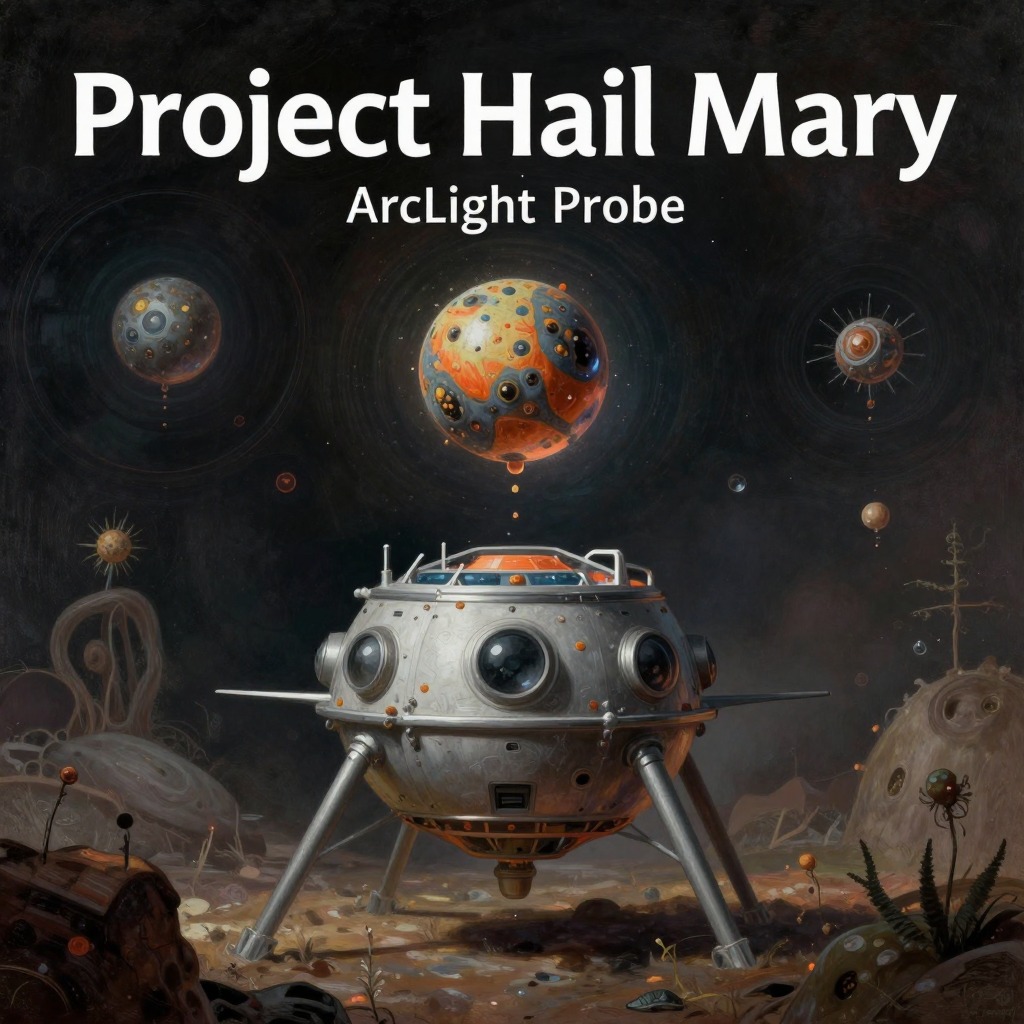
Dr. Browne
Dr. Browne is the head of Planetary Sciences for NASA, introduced during the globally televised broadcast of the ArcLight probe's orbital insertion around Venus. He serves as the public face of the mission's scientific objectives, explaining the probe's purpose and the stakes of the Petrova problem to a worldwide audience. His role is that of a calm, authoritative institutional scientist who is suddenly confronted with the most extraordinary discovery in human history, and his reaction marks the moment the story's central mystery shifts from a physical anomaly to a biological one.
Role in the ArcLight Mission
Dr. Browne appears alongside reporter Sandra Elias in the gallery of a flight-control room at the Jet Propulsion Laboratory in Pasadena, California, as the world watches the live feed. He explains that ArcLight successfully inserted into orbit around Venus and that the team is waiting for the first batch of data. He describes the engineering challenges of the mission, noting that because the launch window was unfavorable, far more fuel was required to get the probe to Venus, and that Venus's fast orbital motion makes it more fuel-intensive to reach than Mars. He also clarifies why the probe targets Venus itself rather than a point in space: the Petrova line is widest there—as wide as the whole planet—and Venus's gravity can assist in collecting samples. Dr. Browne states that the onboard lab is basic, consisting only of a high-magnification microscope and an x-ray spectrometer, and that the real mission is a sample return scheduled for three months later.
Witnessing the Discovery of Extraterrestrial Life
When the first microscope images arrive, showing black dots about ten microns across, Dr. Browne initially cautions that they could be ordinary dust particles attracted by the planet's gravity. But as the images continue to arrive and the dots are seen deforming and shifting, he immediately shifts into investigative mode. He calls out for telemetry to check for any shimmy in the probe that could explain the motion, and asks whether there is a consistent direction of travel that could be explained by an external force such as magnetism or static electricity. When the room falls silent and no one answers, he repeats his question with increasing urgency. His final line in the scene—"Anyone?!"—captures the moment when the scientific framework he represents fails to provide an immediate explanation, and the reality of alien life begins to sink in. His exclamation "Oh my God!" as the images confirm the movement is the first verbal acknowledgment of the discovery by an authority figure, marking the transition from speculation to confirmed observation.
Narrative Significance
Dr. Browne's appearance is brief but structurally crucial. He embodies the established scientific establishment that is both prepared for and utterly unprepared for what it finds. His careful, methodical explanations of the mission's design and limitations establish the credibility of the ArcLight project, making the subsequent discovery more shocking by contrast. His inability to immediately explain the moving dots—despite his expertise and the resources of NASA—underscores the genuinely alien nature of the Astrophage. The scene also serves as the public revelation of extraterrestrial life, witnessed by Ryland Grace from his apartment, and it is this broadcast that sets the stage for Grace's eventual recruitment by Eva Stratt. Dr. Browne's role is that of the institutional scientist whose routine mission is overtaken by an event that redefines the terms of his field.